Empowered Badges — online civic learning about housing and homelessness
Designed and built a self-paced online badge that teaches residents the facts about housing and homelessness in Bloomington, Indiana, plus two interactive explainers: a simulation of the homelessness response system and a hands-on look at a live housing-fee debate. In development; not yet launched.
Context
Empowered.Vote builds tools that help people take part in local government. Local debates about housing and homelessness often stall because people start from different facts. Empowered Badges is a learning prototype for that problem: short online modules that give residents a shared set of facts before they argue about solutions. Completing a module earns a badge.
I designed and built the badges myself, drawing on public data and local reports. The work is still in development and has not been released to learners, so there is no usage data yet.
What I did
Set a clear boundary for what the badge teaches. The first badge covers housing and homelessness in Bloomington. Each badge opens with what the learner will learn, why it matters, and what the badge is not: it teaches what is true, not what ought to happen. That boundary keeps a politically charged topic focused on facts every side can use.
Built a module sequence with checks along the way. The badge has five modules: the numbers, the housing market, the Built for Zero and Housing First approaches, the history, and the current political context. Each module defines its key terms and ends with a knowledge check. To earn the badge, a learner finishes every check and then passes a short final assessment.
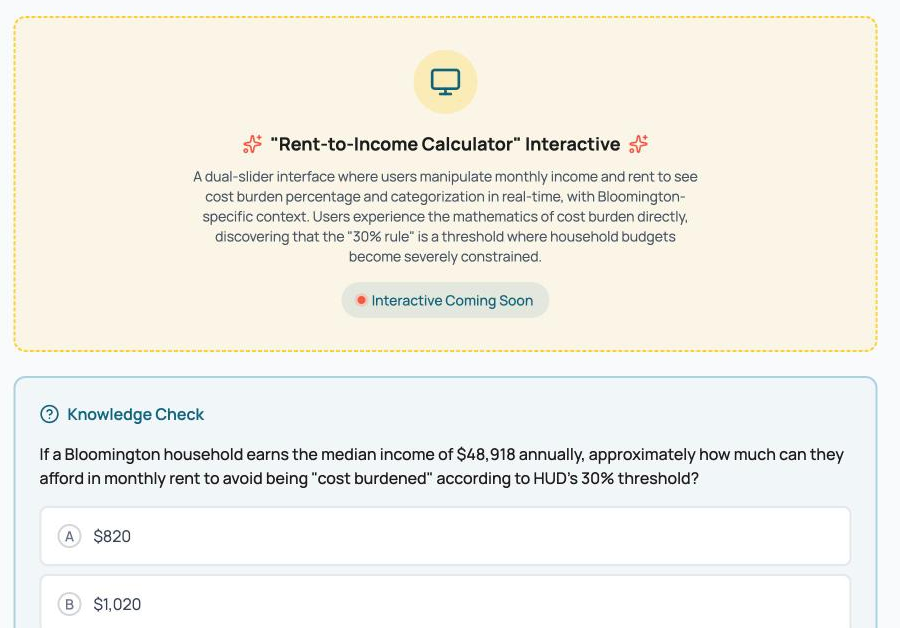
Designed interactives where text was not enough. For each module I specified an interactive that lets learners work with the idea instead of reading about it, such as a calculator that shows when rent becomes a cost burden. These are designed but not yet built.
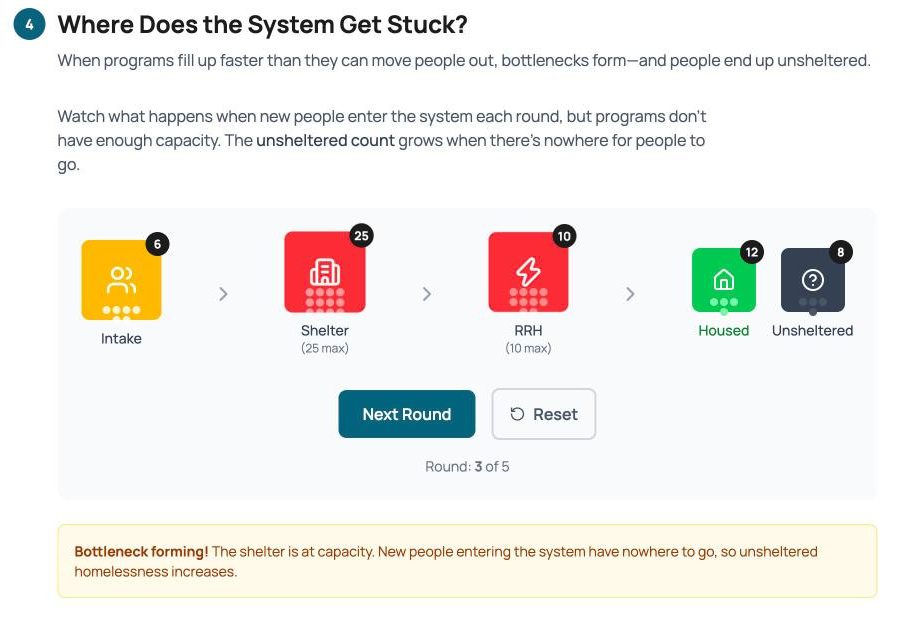
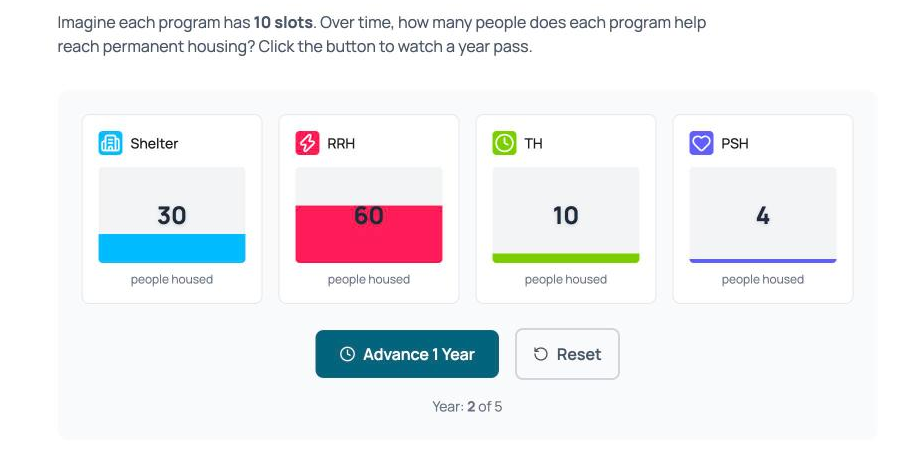
Turned an in-person game into an online simulation. The most developed piece is an interactive explainer of how a community’s homelessness programs work together. Another organization created it as an in-person bead game; I designed and built the online version. Learners watch people move from intake to housing, run programs forward a year at a time to compare how many people each one houses, match people with different needs to the right program, and watch a bottleneck form when a shelter fills up. The last step asks them to act as the system planner and choose one change, with trade-offs.
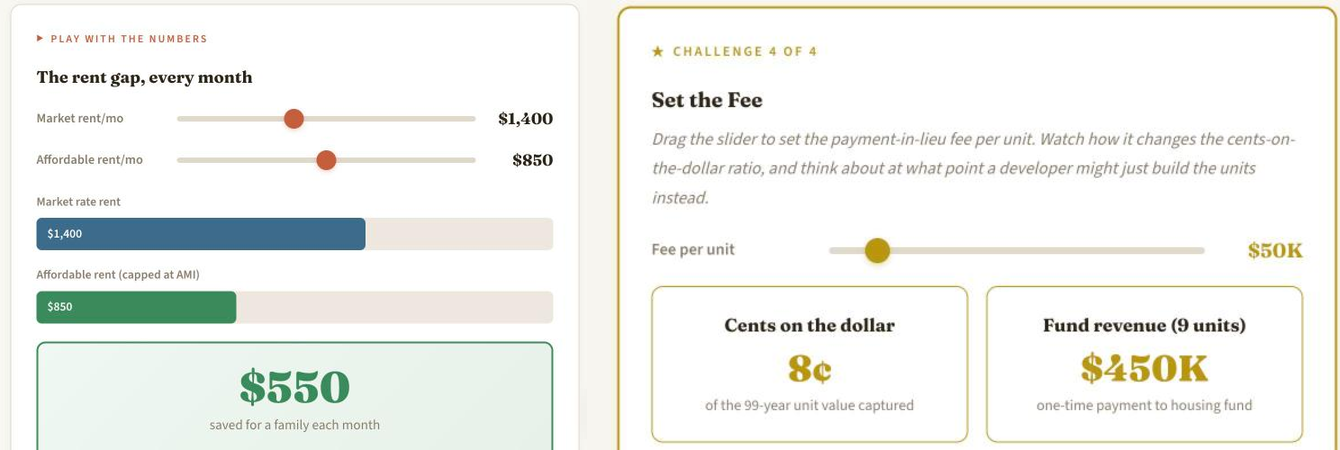
Built an explorable explanation of a live policy debate. In February 2026 Bloomington’s city council raised the fee developers can pay instead of building affordable housing. “The $50,000 Question” lets learners work through that choice themselves. They size a building, move sliders to see the monthly rent gap an affordable unit saves a family, watch that value add up over 99 years, and finally set the fee as if they were the council. Four challenges along the way check understanding, and the closing section lays out the trade-offs without picking a winner. The rent-gap tool is meant to replace some of the housing badge’s planned interactives.
Status
The housing badge and both explainers run online but are not yet open to the public. The next step is testing with real learners.